Pokémon Collector Guides
Everything we know about selling, grading, valuing and shipping Pokémon cards, written by people who do it at a booth every month. Built so you can show up to a trade-in or a grading submission already knowing what you have.
Guides & Explainers
Selling
How to sell a Pokémon collection without getting lowballed
The four mistakes that cost sellers the most money — letting good cards get bulked, pricing off listings instead of completed sales, over-grading your own condition, and shipping badly — plus what a legitimate, itemized offer should actually look like.
Pricing
What percentage of market value do dealers pay?
Nobody pays 100%, and the percentage has to scale with the value of the card or the math does not work. Our full published ladder, why it rises with value, and an honest side-by-side against selling the cards yourself once fees, postage and your own time are counted.
Grading
Should you grade your Pokémon card?
The break-even math, including a number almost nobody publishes: we measured the PSA 10 to Grade 9 price ratio across 58,533 matched Pokémon cards. Median 3.00× overall, 2.98× on modern, 4.42× on pre-2004 vintage — but only 2.89× on the 2004–2019 middle era, so "old" is not the same as vintage. Full method published with it.
Grading
PSA vs CGC vs BGS for Pokémon
They all put the card in a case with a number on it. What differs is how easily you can sell that case afterwards. Resale liquidity, subgrades, cost and turnaround compared honestly — including where each one is the wrong choice.
Authenticity
How to spot fake Pokémon cards
Counterfeits have got much better at color and gloss. What they still cannot fake is the physical construction of the card. The light test, card stock, texture, holofoil pattern, fonts and the back print — in the order that actually catches fakes.
Conditioning
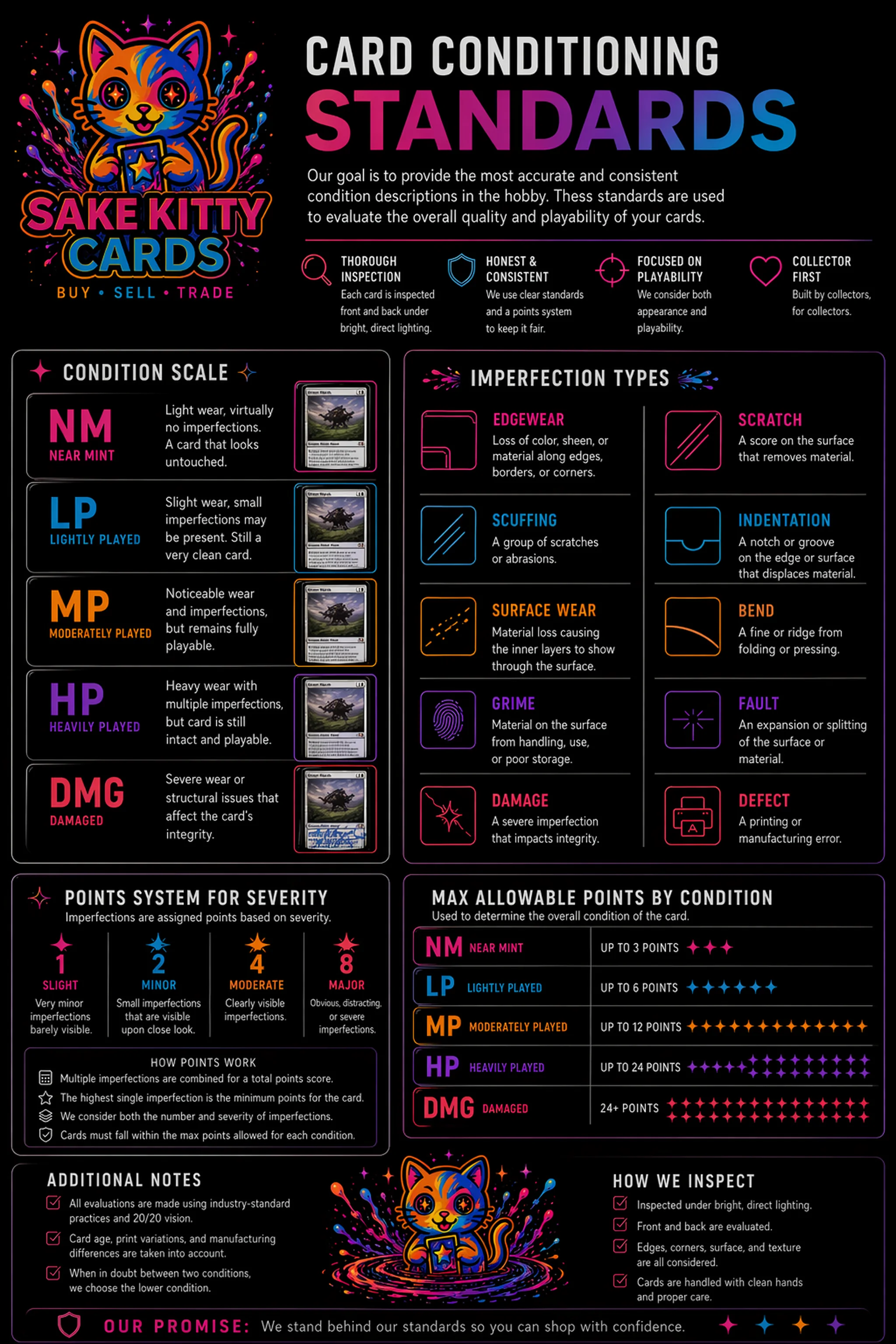
How to read your own cards before shipping them
Sellers grade their own cards about one full tier too generously, almost universally. The four checks we run — edges, corners, surface, centering — what each condition tier actually means, and the exact multipliers our quote tool applies to each one.
Local
Selling to a Florida-local vendor vs. a national buyer
We're not the biggest buyer in the country. Where we beat the national mail-in buyers for Florida collectors: you can hand the cards over in person on either coast, watch them being valued, and walk away paid the same day — against published rates you can sanity-check before you say yes.
Inventory
Why a card on our site sometimes sells before checkout
We're local vendors. We sell at Florida card shows and on the site. If a slab or sealed product is sitting on our shop page, there's a small chance it just sold at a booth and our Square inventory hasn't synced yet (usually within an hour, sometimes longer at a busy show).
Every order is reviewed before we charge. If something sold in person between when you ordered and when we packed it, we offer same-day: full refund, swap for a similar product, or a hold for the next batch. Apparel and merch are print-on-demand so they never go out of stock — only graded, sealed, and singles can lag.
Have a question we didn't cover?
Anything we can clarify — pricing on a specific card, whether something is worth grading, how to pack a fragile slab — just ask.